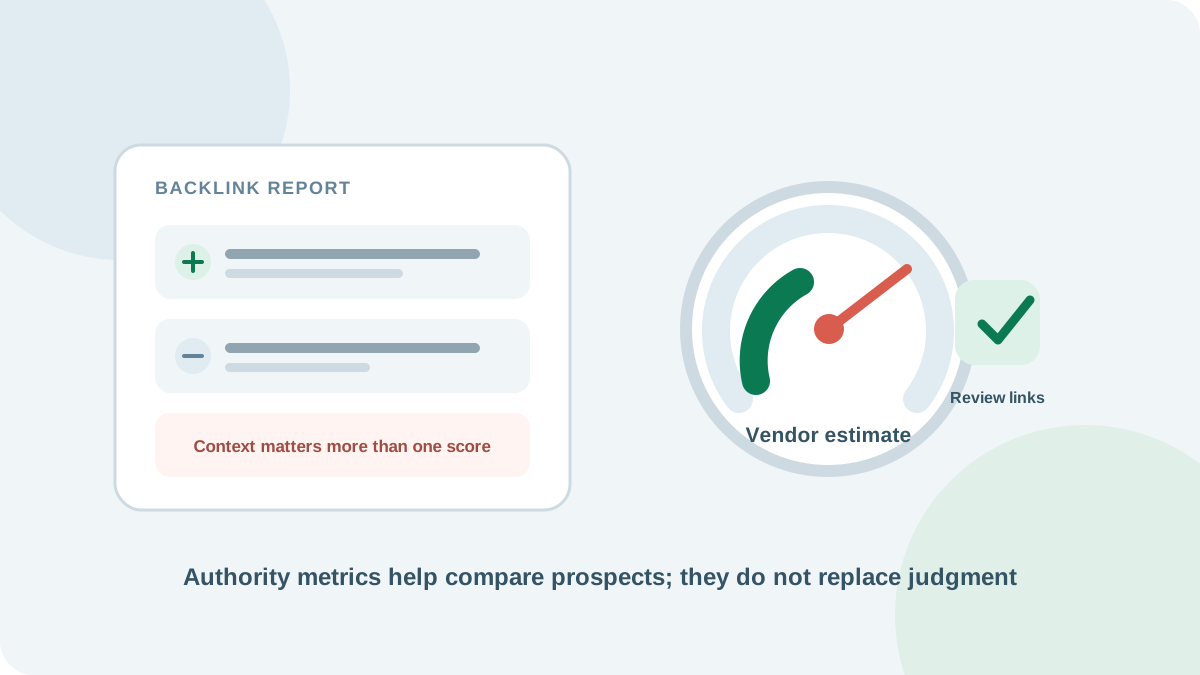
A site authority checker reports a score created by a particular SEO provider. It can help compare websites in that provider's index, but it is not a Google score and cannot tell you on its own whether a site or link is valuable.
Quick answer: Use an authority score as a rough comparison within one tool. Then inspect the site's relevant pages, real referring links, and the visitors those pages could send. Google's PageRank is part of its ranking systems, but a vendor's authority number is not the PageRank value Google uses.
What does a site authority checker measure?
SEO platforms calculate their own measures of a site's link profile. Names such as Domain Authority, Domain Rating, and authority score belong to individual providers; their formulas, crawled link indexes, and scales differ. A score of 40 in one tool is not necessarily equivalent to 40 in another.
Google's guide to Search ranking systems says PageRank remains one of its link-analysis systems, while noting that how it works has evolved. The old public Toolbar PageRank display was discontinued. A third-party score is therefore best treated as an outside estimate for comparison, not a report of Google's internal signals or a guaranteed ranking forecast.
How to use an authority checker responsibly
- Use the same provider and scope. Compare root domains with root domains, or individual pages with individual pages. Record the date because each provider refreshes its data on its own schedule.
- Look beyond the total. Review example referring domains, the pages that link, the destination pages, and the context around each link. A small number of relevant citations can be more useful to your audience than a large count from unrelated pages.
- Check whether the link is live and useful. Open a sample of source pages. Confirm the link exists, the destination loads, and a reader would have a reason to follow it.
- Consider the likely audience. A site may have a modest score but reach exactly the people you serve. Think about relevance, editorial quality, and whether real visitors could discover your page there.
- Track outcomes that matter. Note relevant referral visits, enquiries, mentions, and links to useful pages. A change in an outside score alone is not evidence that business results or Google rankings changed.
When comparing potential linking sites
Use the score to sort a long list into a manageable review queue, not to make the final decision. Look for a page that discusses a related subject, cites sources naturally, and serves an actual audience. Check the exact URL that would link to you; a domain-level number may hide the quality or relevance of that page.
If you are checking your own site's incoming links, begin with the Search Console Links report for Google's sample of links to a verified property. For a wider discovery or competitor view, use a third-party backlink index. Our incoming links checker guide explains what those reports can and cannot show.
After you find important destination URLs, the SEO Wins Bulk URL Checker can check status, redirects, and indexability for a batch of URLs. Its Broken Link Checker checks links found on an individual page. Neither tool calculates a domain authority score or maintains a web-wide backlink index.
Avoid score chasing and link schemes
Do not buy links, exchange links at scale, or publish low-value articles mainly to place keyword-rich links. Google's spam policies describe link schemes as links created primarily to manipulate rankings. Paid placements and sponsorships should be qualified with an appropriate relationship attribute such as rel="sponsored".
Earn references by publishing something worth citing: original data, a clear explanation, a useful calculator, or a resource that makes another writer's job easier. A score can help organize outreach research, but the page and its audience are what you should evaluate.
Frequently asked questions
Is Domain Authority a Google ranking factor?
Domain Authority is a third-party provider's metric, not a Google metric. Google has its own ranking systems, including an evolved version of PageRank; no external authority score reveals the full set of Google signals for a site.
Can a high authority score guarantee rankings?
No. It is an estimate based on one provider's data and method. It does not guarantee that a particular page will rank, attract visitors, or earn conversions.
Does SEO Wins have a site authority checker?
No. SEO Wins does not calculate authority scores or provide a web-wide backlink index. It can help audit page-level SEO, check links found on a page, and check batches of destination URLs.