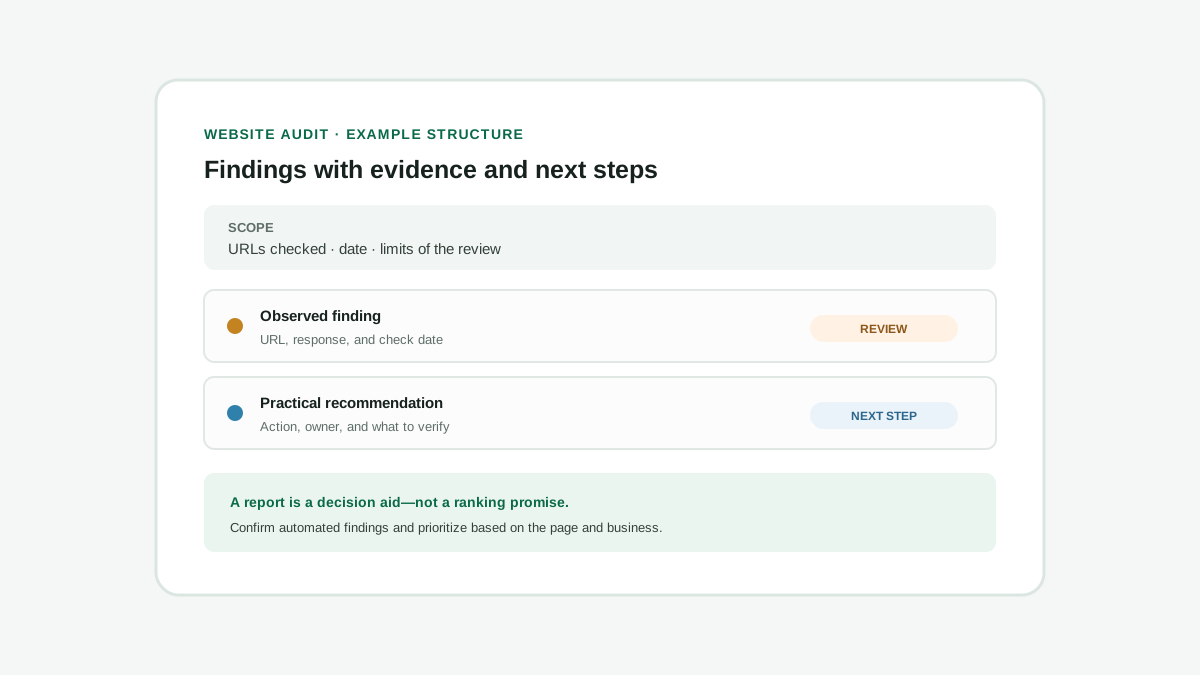
A useful SEO audit report explains what was checked, what was found, and what to do next. The best format depends on the site and the person who will use it; a long list of warnings without evidence or priorities is not a plan.
Example, not live data: the findings below illustrate report structure. They are not measurements of your website or a promise that each issue affects rankings.
Begin with scope and date
State whether the review covers one page, a sample of URLs, or the whole site. Include the date, target country or audience when relevant, tools and access used, and any limitations. A page-level automated audit should not be presented as a full technical SEO audit service or whole-site review.
For example, “We checked the homepage and 20 priority URLs on 26 October using fetched HTML. JavaScript-rendered content, analytics configuration, and server logs were outside this review.” That note helps the reader understand what the findings can and cannot say.
Show evidence beside each finding
Each item should include the URL, the observed condition, why it matters for the task, a practical fix, and a way to confirm the repair. Separate evidence from interpretation. For instance, “the page returned HTTP 404 at the time of the check” is evidence; “this is the reason the site's traffic fell” would need additional evidence.
| Example finding | Evidence to include | Possible next step |
|---|---|---|
| Page returns an error | Checked URL, status, final URL, and check date | Confirm whether the page should exist; restore it, redirect to a close replacement, or leave a proper 404/410. |
| Title is missing or unclear | Current title (or none), page topic, and intended audience | Write a concise title that describes the page accurately, then review the live search snippet later. |
| Important image has no text alternative | Image URL and nearby content | Add alt text that describes the image's purpose, or leave it empty if decorative. |
Organize a report by useful work
Common sections include crawl and indexability, page titles and descriptions, headings and content, internal and external links, images, redirects, structured data, mobile experience, and performance. Add accessibility, conversion, local, or ecommerce observations only when they were actually reviewed.
Label findings by urgency and explain the reason. A broken canonical on a key page may deserve attention before a minor wording suggestion. Do not use a single numerical score to hide differences between technical access, content quality, and user experience.
Prioritize with owners and follow-up checks
Make recommendations specific enough to act on: name the page or template, describe the change, identify the person or team responsible, and list what to verify after deployment. If a recommendation depends on more research—such as whether a page should be redirected—say so instead of making an irreversible change from a single crawl.
- Fix confirmed access or indexability problems on important pages.
- Resolve broken links and unnecessary redirect chains.
- Improve page content and titles where the search need is clear.
- Recheck affected URLs and compare search data over a suitable period.
Where automated SEO reports help—and where they stop
An automated report is useful for repeatable checks such as HTTP status, title presence, heading structure, links, metadata, and some markup. It can save time and make a baseline easier to share. It cannot reliably judge whether a page is the best answer, whether a traffic change has one cause, or what Google will rank next.
Review automated alerts before sending them to a client or making a site change. A crawler may be blocked, a page may be intentionally noindex, or a third-party host may reject the checker. Keep the raw observation and let a person decide what action fits the site.
Try the same approach on a real page
The SEOWins page audit checks one public URL and can produce a PDF report. Use the bulk URL checker for a list of pages, and the broken-link checker to review links on a page. Each tool describes its scope, and its score is a checklist aid rather than a Google ranking measure.
For an end-to-end review process, follow the 14-point SEO audit checklist. Google's SEO Starter Guide explains the fundamentals behind many of these checks.